Trusted by B2B SaaS teams



AI Automation
AI automation for B2B SaaS marketing and revenue teams. Build agents, workflows, and context engineering systems that turn weeks of manual work into minutes. Installed inside your team's tools, powered by your brand and POV, and kept under real human judgment.
Project-based builds or ongoing retainer. Agents and automations for content, demand gen, SEO, and sales operations.
Trusted by B2B SaaS teams
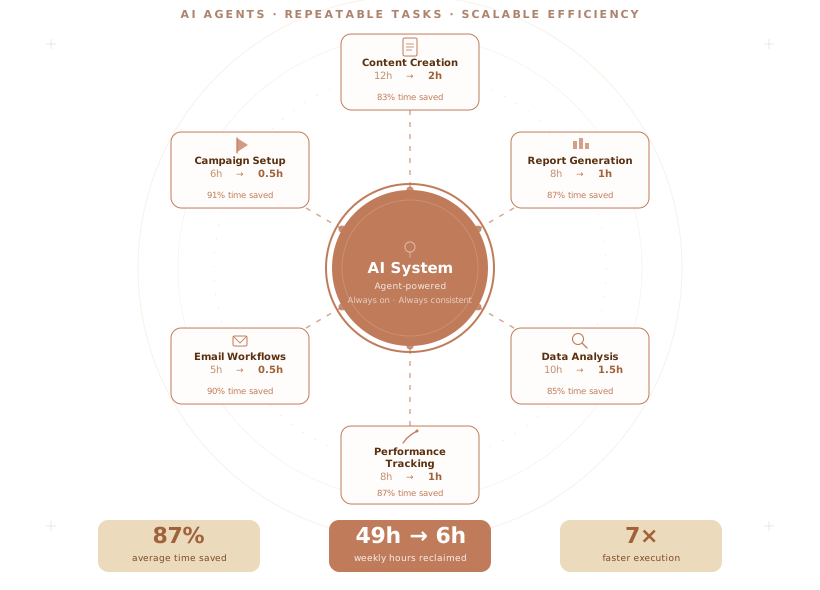
The pattern shows up in almost every marketing and revenue team right now. Everyone is using AI. ChatGPT, Claude, Copilot, a dozen niche tools. People draft content with it, brainstorm with it, summarize meetings with it. The output feels faster. The team feels more productive. The work mostly looks the same.
That's the problem.
The big opportunity isn't drafting faster. It's replacing entire repeatable workflows — the ones being done manually, over and over, by marketers and sellers every day. Campaign setup. Creative variants. Audience research. Content briefs. SEO audits. Account research for ABM. First-draft sales outreach. Reporting. Lead scoring. Competitive monitoring. Each of these takes hours. Most of them can be systems that take minutes.
The quality of any AI output is capped by the quality of the context you give it. Most teams run AI tools with almost no context — no brand doc loaded, no ICP defined, no positioning framework, no writing standards. The result is average output at scale. Shipping AI-generated work without deep context doesn't make the team faster. It makes the work worse, faster.
Which chat interface, which plugin, which integration — these questions get debated endlessly. The more important question is what systems you're building around the AI layer, and what stays human.
A real AI automation practice runs on three ideas that most teams skip.
A prompt library saves a few minutes per task. A system — triggered by a real event, with inputs pulled from your stack, running through a sequence of AI and human steps, delivering output into a tool your team already uses — changes how the organization operates. The work happens whether or not someone remembers to run a prompt.
Brand guidelines, ICP definitions, positioning frameworks, writing standards, product documentation, competitive intelligence — all loaded into the AI layer deliberately and maintained as part of the operation. The difference between a generic ChatGPT draft and an on-brand, positioning-aware, audience-specific piece of work is entirely the context.
AI and automation handle execution. Direction, quality control, and what-to-build-next stay human. The role of the marketer or operator shifts from doing the task to directing the system that does the task. The most valuable humans in an agent-driven operation are the ones building and governing the systems, not the ones racing against them.
AI automation isn't a standalone practice. It's the capability layer that makes every other marketing and revenue function faster, sharper, and more scalable.
Content Marketing
AI systems that turn SME interviews into structured first drafts, produce audience-specific variants, generate SEO and AEO metadata automatically, and repurpose long-form content across LinkedIn, YouTube scripts, and email. Context engineering ensures every output holds the brand POV and voice.
Demand Gen & Paid Ads
Agents that research ICP accounts, generate ad creative variants, test copy at scale, automate campaign reporting, and monitor competitive landscape. Paid ops workflows that used to take an analyst a week run in hours.
SEO / AEO / GEO
Automations for technical SEO monitoring, content gap analysis, AI citation tracking across ChatGPT, Claude, and Perplexity, schema generation, and llms.txt maintenance. Agents that flag when AI overviews change for your priority queries.
Sales Operations
Account research agents that brief sales reps before every call. Inbound lead qualification and routing. Personalized first-touch outreach drafted with real context on the account. Pipeline monitoring and follow-up systems.
GTM Operations
Positioning and messaging enforcement across every AI-generated output. Onboarding workflows for new team members that load full brand and GTM context into their tooling on day one. Competitive intelligence and market monitoring systems.
AI automation delivered as either a fixed-scope build project or an ongoing retainer. Four components, working together:
Review of current AI usage across the team, context quality assessment, and identification of the highest-ROI automation opportunities. Map the workflows that should be systems, the workflows that should stay human, and the ones that shouldn't exist at all. Output is a prioritized build roadmap.
Build the foundational context layer. Brand guidelines, ICP documentation, positioning frameworks, writing standards, proof point libraries, and product documentation — structured in a format the AI layer can actually use. This is the infrastructure every automation downstream runs on.
Custom agents and automations built in the tools your team already uses — n8n, Zapier, Make, custom GPTs, Claude projects, Gumloop, Relevance AI, or purpose-built code where needed. Integrated with your CRM, your content tools, your ad platforms, your data stack. Shipped with documentation, ownership assignment, and a clear handoff.
Systems only work if the team uses them. Includes training, playbooks, and governance — who owns what, how agents get updated, what quality standards apply, how human review stays in the loop. Without this layer, AI builds get abandoned within a quarter.
Every engagement is built around the specific business, but the patterns repeat. A few of the highest-leverage systems to build first:
An agent that takes a recorded interview with a subject matter expert, extracts the usable insights, structures them into outline form, generates a first draft in the brand voice, and delivers it into the editor's workflow. Reduces the time from interview to draft by 70% or more.
An agent that fires on every new inbound lead. Pulls public data on the account, checks against ICP criteria, scores the lead, generates a briefing doc for the sales rep with talking points and relevant case studies, and routes it into CRM.
Agents that monitor competitor websites, LinkedIn, Google SERPs, AI overviews, and review platforms for material changes. Flag pricing changes, new feature launches, positioning shifts, and negative reviews. Deliver a weekly briefing.
An agent that takes a core ad concept and produces structured variants across audiences, formats, and platforms. Feeds directly into paid media testing cycles. Keeps variants on-brand because the brand context is loaded into the system itself.
An agent that queries ChatGPT, Claude, and Perplexity weekly for your priority category and competitor queries. Tracks whether your brand is cited, how it's framed, and how that changes over time. Feeds into the SEO / AEO / GEO engagement.
An agent that takes a target account list, pulls public signals and funding data, identifies the likely buying committee, drafts a point of view on what would matter to that company, and hands a structured brief to the sales and marketing teams.
These aren't templates. Each one is built for the specific business context, loaded with brand and positioning inputs, integrated into the existing stack, and kept under human review.
6–10 weeks · Fixed scope
Best for teams that know the priority workflow they want to automate and want it shipped quickly.
Monthly partnership
Best for teams that want AI automation as an ongoing competitive advantage.
Most engagements start with a build sprint to prove the model and convert to a retainer as the capability compounds across functions.
Both. The engagement includes strategy (what to build and why), context engineering (the infrastructure), and the actual technical build (agents, workflows, integrations). For complex custom development, I bring in specialist engineers as needed. Most work ships on established automation and AI platforms, not custom code.
Whatever fits the workflow and the team's stack. Common tools: Claude projects, custom GPTs, n8n, Zapier, Make, Gumloop, Relevance AI, and direct API integrations for higher-complexity work. Tool selection is a downstream decision — the workflow gets designed first, the tool gets chosen to fit.
Point-solution AI products solve one problem with one vendor's opinion of how it should be solved. An AI automation engagement solves your specific workflows with your specific context, integrated into your specific stack. For many teams, both coexist — off-the-shelf tools for commodity problems, custom systems for the workflows that create competitive advantage.
No. The goal is to remove the low-judgment, repetitive work so the team can focus on the high-judgment work. Every build includes an explicit decision about what stays human. Teams that run AI automation well typically hire for higher-leverage roles afterward, not fewer people overall.
Yes. The AI automation practice is most powerful when it plugs into an existing marketing system. If you're already running one of the tactical engagements, adding AI automation compounds the leverage. If you're starting fresh, we'd usually start with one tactical service and install the AI automation layer inside it.
First systems usually ship inside 2 to 4 weeks on a build sprint. Complex multi-system builds take 6 to 10 weeks. The longest part of most projects is not the technical build — it's context engineering and team adoption.
Every engagement includes governance design: who owns what, what gets reviewed by a human, what data can and can't flow through external models, what happens when the AI gets it wrong. For regulated industries, this work gets extended. The systems are built to be accountable, not autonomous without oversight.
Build sprints are fixed-scope with defined fees. Retainers depend on the scope of ongoing work and number of systems under management. Covered on the strategy call once priorities are clear.
Get Started
The strategy call is a focused 30-minute conversation. We review where your team is spending manual hours today, which workflows should become systems, and whether an AI automation engagement is the right next investment. No pitch deck. No vendor recommendations. If it's not a fit, you leave with a clearer read on what should come next.
Book a strategy call →